
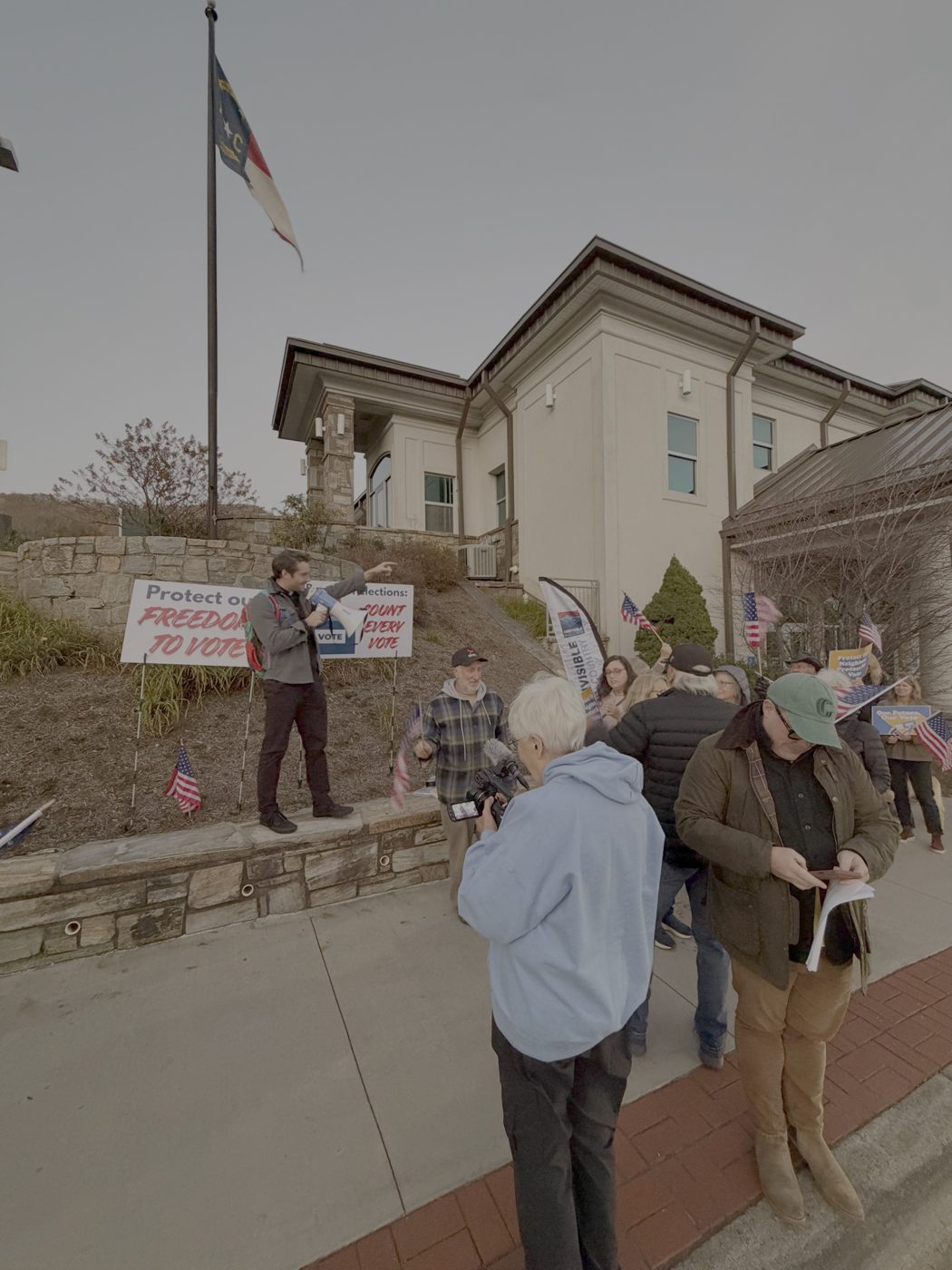
County boards across the 5th District were scheduled to canvass the Nov. 3 count at 11 a.m. today, the last local step before the State Board certifies on Nov. 24. Since then, the State Board's unofficial results file has changed slightly, with updates appearing in Watauga by early afternoon and Guilford by mid-afternoon. We don't have a signed canvass result from Watauga or Ashe yet, so every number below is the State Board's unofficial file.
Here is where the 5th District stands. Chuck Hubbard, the Democrat, leads Virginia Foxx 139,770 to 139,439. That's 331 votes, down from 334 earlier Friday after Guilford's totals ticked down a few votes. Robert Luffman, the Libertarian, has 7,579. These are the State Board's numbers as of 3:41 p.m. Friday, and they're unofficial.
How we voted
Watauga went blue, with Hubbard taking it 14,982 to 8,314, or 62.5 percent. Ashe went Foxx, 7,244 to 4,187, or 61.3 percent. Watauga and Guilford carried the district for Hubbard. The other eight counties went red for Foxx.
Up here the two counties split down the ballot. Watauga went for Roy Cooper for U.S. Senate, Frank Hughes for state Senate and Charlie Wallin for state House, all by wide margins. Ashe went for Michael Whatley, Ralph Hise and Ray Pickett by about as much.
Across the full districts, Hise leads the state Senate race with 55.5 percent. Wallin leads House 93, 19,070 to 18,729, and Pickett has conceded and congratulated him, according to local reporting.
Boone Mayor Dalton George didn't see this coming.
On a Nov. 10 episode of his podcast, Do You Even Live Here?, he said he was "jealous" when Fletcher Mayor Preston Blakely's district flipped early on election night, with no expectation the 5th would do the same.
"That's a tough district," George said. "And sure enough, I was wrong. I'm very glad to be wrong."
Watauga voted for Len Hagaman for sheriff, about 68 percent to Darin Church's 32 percent. Ashe's B. Phil Howell ran unopposed.
Both counties voted for all three constitutional amendments, but not the same way. Watauga barely, at 51.4 percent for photo ID, 53.5 for the income tax cap and 52.0 for the property tax levy limit. Ashe wasn't close, at 73.2, 70.3 and 66.4 percent.
Opponents had argued the changes lock too much into the constitution. They said the income tax cap ties the state's hands in an emergency, that one limit can't account for the differences between counties, and that photo ID adds obstacles for voters and doesn't belong in the constitution. At an Oct. 1 candidates forum, Watauga County commissioner candidates Adam Hege and Ray Russell, both Democrats, said they opposed the levy limit, and Russell urged a no vote. Republican Savva Kostis said no one could say what the limit would be. Statewide, all three passed with about 60 percent, according to unofficial results.
What comes next
With the 5th inside the 1 percent line, Foxx can ask for a recount. The district crosses counties, so the request goes to the State Board by noon Tuesday, Nov. 17. Foxx said last week the count wasn't over, and reports differ on whether she has already called for a recount. A public call for a recount isn't a filing. The formal request can come only after the canvass, and we haven't seen one. House 93 was inside the same line at 0.9 percent, but Pickett's concession makes a request there unlikely. A full machine recount should be done by Nov. 23, the State Board says, and the board meets Nov. 24 at 11 a.m. to certify. Our recount explainer walks through it.
Hubbard isn't waiting. He spent this week at new member orientation in Washington with the incoming class, according to his own campaign Facebook page. We're tracking his road to the oath in a separate story.
What Hubbard has promised
If the lead holds, we get a new member of Congress in January. He arrives without the seniority Foxx built over two decades, so his campaign promises are the yardstick for what he does with the seat. Here is what he's put on his campaign site, and where Foxx's record points the other way.
Medicaid and Medicare. He says he will "fight against any attacks on these programs." Foxx voted yes on the 2025 federal budget law, when the House first passed it May 22 and again on the final vote July 3. The Kaiser Family Foundation, using Congressional Budget Office estimates, puts the cut to federal Medicaid spending at about $911 billion over ten years. Hubbard hasn't promised to repeal it. He has promised to protect the programs.
In short, Foxx voted for the law that cut Medicaid, and Hubbard says he'll fight cuts to it. He hasn't said whether he would undo this one.
Rural health. He wants a government option to support rural health and "a hospital within a short drive of every community." That's a proposed new federal commitment, not a reversal of a specific Foxx vote. His site doesn't say what the option would be or how it would be paid for.
Helene. He says he'll fight for "the funding we were promised" and demand FEMA transparency. In January, the federal Department of Homeland Security announced $116 million in newly approved FEMA grants for North Carolina's Helene recovery, according to FOX Carolina's report on the release. That included $34.7 million for road and bridge repairs at more than 300 sites across Watauga, Ashe and seven other counties, and the department thanked Foxx by name. Nobody has shown us what has been announced, what has been obligated and what has actually arrived. We're going to ask.
George said on the same episode that he hopes the new members will "fight for our Hurricane Helene dollars."
His site also lists a ban on stock trading in Congress, overturning Citizens United, a higher minimum wage and rural broadband. His campaign site doesn't identify a bill or timeline for any of those proposals. We haven't verified where Foxx stands on those, so we're leaving her out of it until we have.
We sent questions Friday to Hubbard's campaign and Foxx's office. We'll publish their answers, or tell you if we don't get any. If you work in either office and can help explain how the transition will work, get in touch.