
WASU and the last humans picking the next song
College radio is one of the last places where a human picks what plays next. Inside WASU with director Dave Blanks and the students deciding what 90.5 plays.
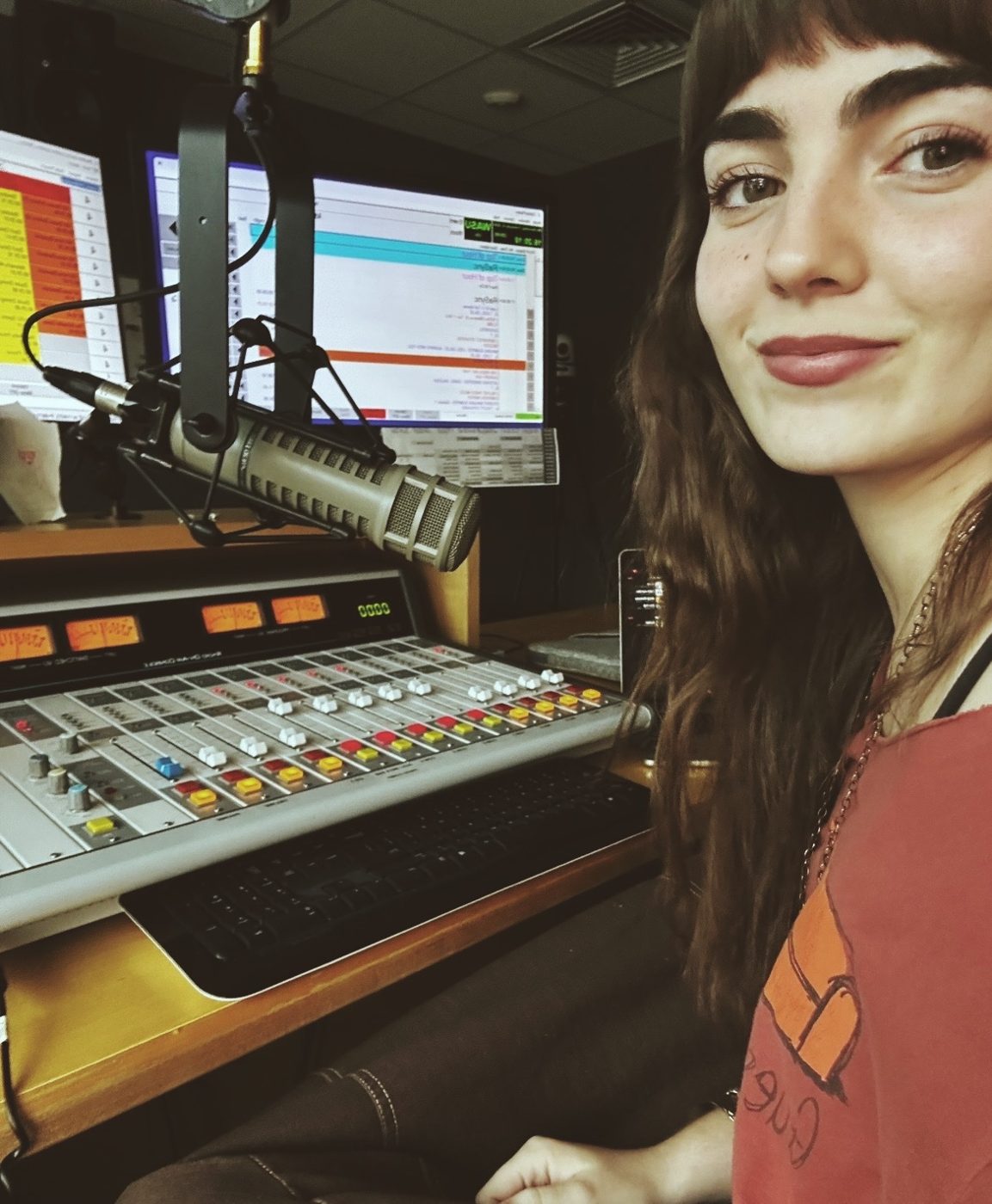
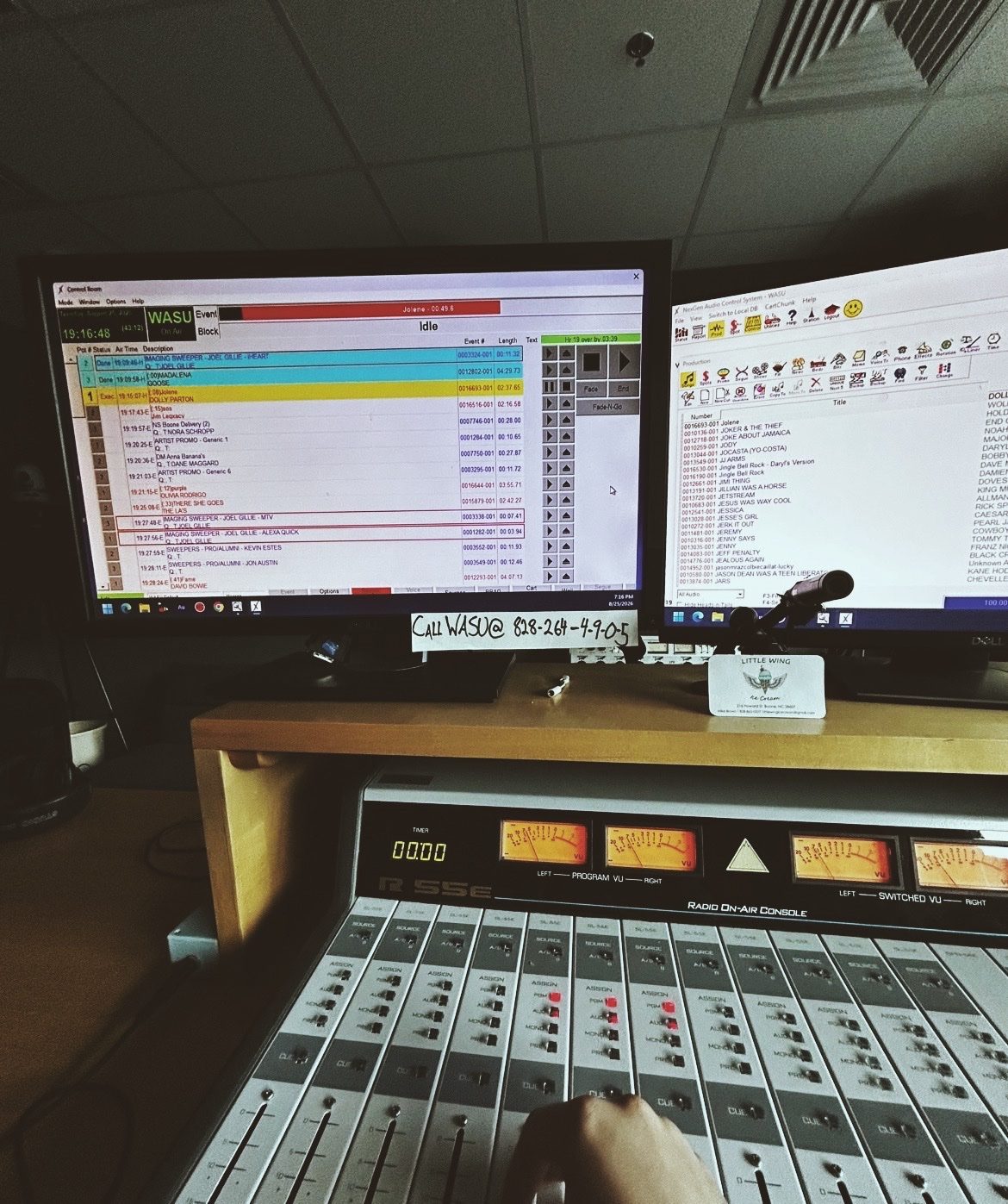
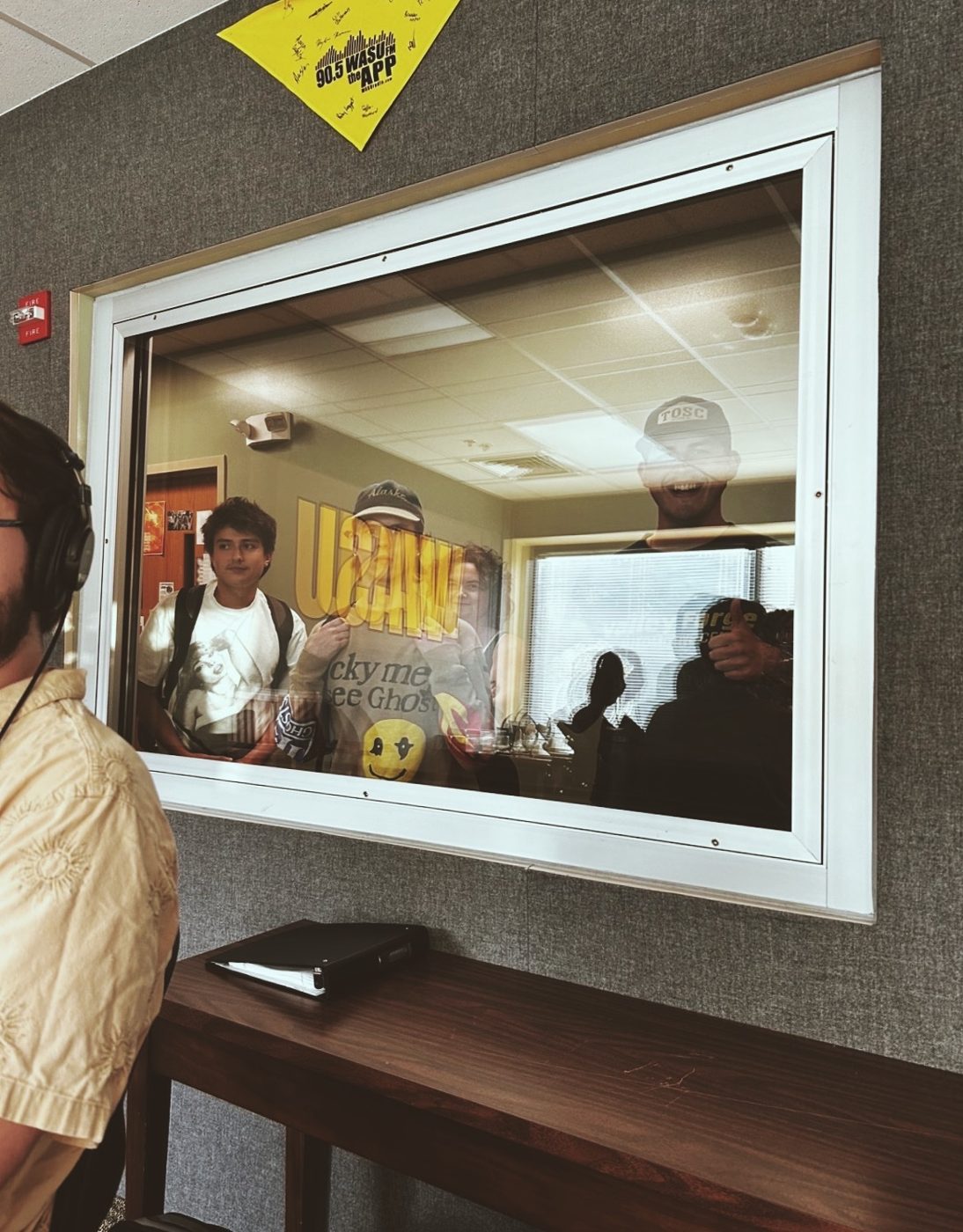
Hattie Atkins, WASU's music director, at the board in the on-air studio.
Photos by WASU
I heard WASU before I saw it. Driving up Rivers Street to the Beasley Media Complex, I had it on the actual radio in my car, not an app, not a stream, the dial turned to 90.5. To me, that's not a small thing. It's most of the reason this piece exists.
I walked in past the on-air studio and there was the DJ, the same voice, working the boards through the window. A person, not a playlist. He picked what came next, in real time, for whoever else happened to have the dial on 90.5.
Dave Blanks, WASU's director and advisor, met me in his office a few doors down. Fish tanks line the walls, planted with live plants, not plastic. Photos of past WASU leadership hang on the wall, and a cassette deck sits on the floor with a stack of tapes nearby on the shelf. It's the office of somebody who picks things on purpose, which turns out to be the whole job. He had the station playing low while we chatted and got ready for the interview.
A few minutes in, that same DJ knocked and leaned in. Not to ask for anything. Just to tell Blanks that he'd loved how the song they'd just played ended. Then he was gone, back to the board. It lasted maybe ten seconds and it was the most honest argument for the whole format I heard all day.
When Blanks arrived in May of 2025, about four students were holding the whole operation up, with a few Comm Department staffers pitching in between their actual jobs. They kept the signal on the air through what he calls a rough handoff. COVID had broken the usual student-to-student training a few years earlier, and not long after, the longtime station director retired. For a while, nobody was really minding the store. The remote broadcast gear needed tuning that a student, not Blanks, eventually diagnosed. The microphones had no shock mounts, so touching the table sent a thud straight over the air. The console hadn't been cleaned in years. And the music library had barely grown. Blanks still brings up one Green Day song, "The American Dream Is Killing Me." He remembers it getting played so often that people were sick of it.
A year and a half later, it's mostly small fixes that stuck. Shock mounts installed, a cleaned console, one new piece of gear for remote broadcasts, and a library that's actually growing again.
WASU's own slogan is “Your college, Your station, Your music.” Commercial radio chases the largest possible audience because it has advertising to sell. College radio doesn't have to, and Blanks leans into that gap on purpose.
Born in Boone and raised in Georgia, where his dad's people come from, Blanks came back up the mountain for App State and stuck. Close to thirty years now, and it shows. He clearly appreciates the people who shaped WASU before him, from Dr. Carl Tyrie, whose Broadcast Newswriting class he took as a student here in the early 2000s, to Dan "Vallie" Hill, the longtime station director and 40-year broadcasting lifer who led its move into the Beasley Media Complex. He's just as clearly excited about where he wants to take the station next.
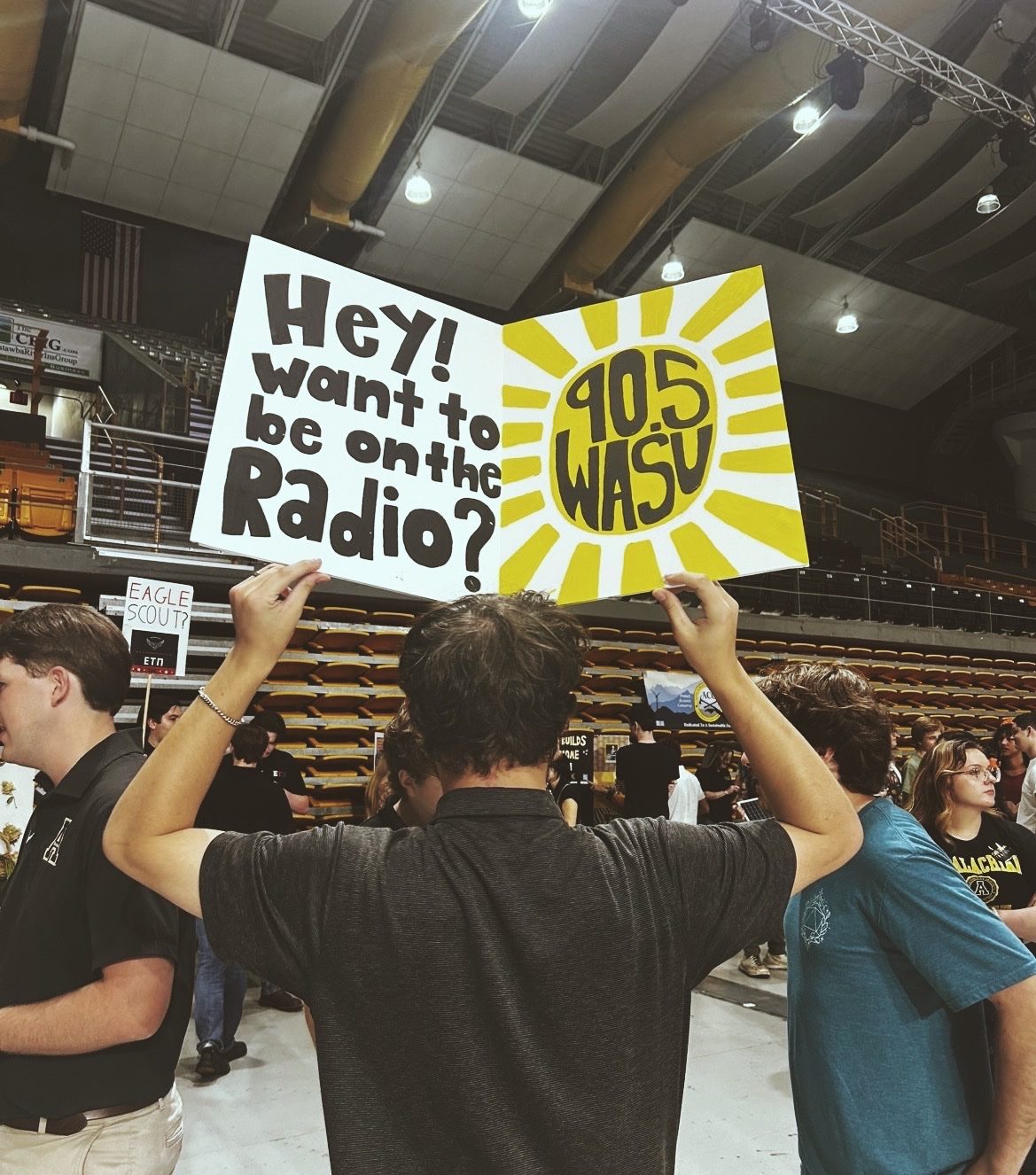
Forty to fifty student voices go live on 90.5 in a given week, by Blanks's own count. Sixteen on paid staff. There are two ways onto the air. The long way is a Monday-night class Blanks teaches on FCC rules and radio history, grown from 14 students to 25 since he took it over. Finish it and you get your own two-hour shift and close to free rein over what plays, as long as a listener could plausibly sit through it. A two-hour field recording of your dishwasher does not count. The short way is new. Blanks added a training coordinator so nobody has to wait a semester for a seat in his class. "I want people to be able to get involved as soon as they are interested," he says. "If they have to wait until next semester to get signed up for my class, we may lose them completely." Two weeks of training and a live studio exam gets you on air as what Blanks calls a flex DJ, training wheels still on until you earn the full shift.
The DJ who knocked on Blanks's door that day is Ethan Shackford, a junior in electronic media broadcasting. He took Blanks's class last spring, and this is his first semester on the air. The song was "Hear Me Out" by Frou Frou, Imogen Heap's early-2000s side project. He'd found the album the night before. On the second listen he caught that the whole backing track is built on a sample of Brian Eno's "An Ending (Ascent)," the track he and his roommate first bonded over.
"That particular song means the world to me," he says. "For it to be used and reinterpreted by a musician that I very much so respect, and I think did it justice, I was thrilled."
Nobody at WASU knows exactly who's out there on any given hour. Ethan doesn't either, though plenty of his friends tune in regularly. "I've never felt like I'm just shouting through the void," he says. "I always feel like it is going somewhere."
He doesn't treat the board like a desk job, either. "I treat it like it's my own personal venue," he says. He cranks the music up, keeps notes on his laptop about every song so he has something to say between them, and jams out. He'd burn incense in there if he could.
For Ethan, most hours get planned around a theme, but the best moves happen off-script. On the day we talked, running short near the end of his hour, he looked back at what he'd already played. His second track had been Barry Adamson's "Something Wicked This Way Comes," off the Lost Highway soundtrack. So instead of whatever he'd planned, he slid in Bobby Vinton's "Blue Velvet." Avant-garde lounge jazz to a 1960s crooner, and the only road between them runs through David Lynch. No recommendation engine takes that turn.
"It's sort of like constellations," he says. "These things do exist sort of in isolation, but our memories connect them to these other things. And that's how you get to places that you would never get with an algorithm."
His advice for listeners is the same thing he does on air. "Just like what you like and take pride in it, and then let that drive you to discover new things."
Ethan's songs, and everyone else's, pass through Hattie Atkins first. She's WASU's music director, an anthropology major who started DJing last year with zero radio background and got hooked in Blanks's class. She also plays harp. The job is the part nobody hears. She downloads, levels, trims and crossfades every DJ's picks and loads them into the system, for a schedule with somebody on nearly every hour of the day. She calls it "very time-consuming, very full of love."
She still gets stage fright. "When that mic is on," she says, "everything mutes," and it hits her that it's her voice going out. Some nights it does feel like nobody's out there. Then a text comes in. Sometimes it's her mom with a "Good job, Hattie." Sometimes it's the last person she'd expect.
Early on, a technical slip left 90.5 in dead air for about 20 seconds. She had no idea what to do. Blanks came through the door. "Talk. Talk." She hasn't forgotten it.
"When you're on air and something goes wrong, you talk to everyone and you tell them what's happening," she says. "You're not by yourself."
She and Ethan overlap a lot, usually in the middle of the night when nobody else is at the station and they're working out who gets the computer. He'll tell her what he's planning to play tomorrow and why. She remembers him building a coming-of-age show recently, running some of his kookiest picks past her and asking if he could really play them. "Play it. Play it," she told him. That's how she tries to run the music side, not official policy. Explain why a song matters to you and she'll back you, even if it's spoken word and "super pretentious or annoying." "We're a college radio station," she says. "I feel like our duty is to bring new weird music to people."
"When you choose to listen to the radio," she says, "you're accepting another person."
WASU's reach past the studio walls has grown too. Battle of the Bands used to take over the parking lot under Beasley itself, and this year it's back, a joint effort with Appalachian Popular Programming Society. Corner Concerts, with App TV, is WASU's version of a Tiny Desk set for regional bands. Local bands make the rotation, Resonant Mirage right alongside Rainbow Kitten Surprise, who started here.
The bigger ambition is the signal itself.
Blanks wants WASU broadcasting on three channels instead of one. It's called HD radio, and it isn't about picture quality. The idea is a digital signal riding alongside the regular FM broadcast on the same frequency, so a compatible radio can tune to something like 90.5.1 without WASU needing a new spot on the dial. That's room enough for the current FM, a digital copy of it that sounds noticeably cleaner, and a third channel he's picturing as talk, news, and sports. None of that happens without a beefier transmitter, a second studio, and a lot of waiting on the FCC, which is not famous for speed. In the meantime, he's pushing the paperwork to roughly double the station's transmitting power, up from its current 220 watts, sometime in the next year.
He also wants WASU ready to serve as an emergency communications resource for Boone and the county, the kind of job radio can do when a phone has no signal. I heard exactly that on my own ham radio through Helene while the wifi was down, people staying on the air for each other.
"That's one thing radio can do better than the internet," he says.
The rest of his wish list is short. Sound better and reach farther than WASU ever has, keep everybody safe and happy, and play really cool music the whole time.
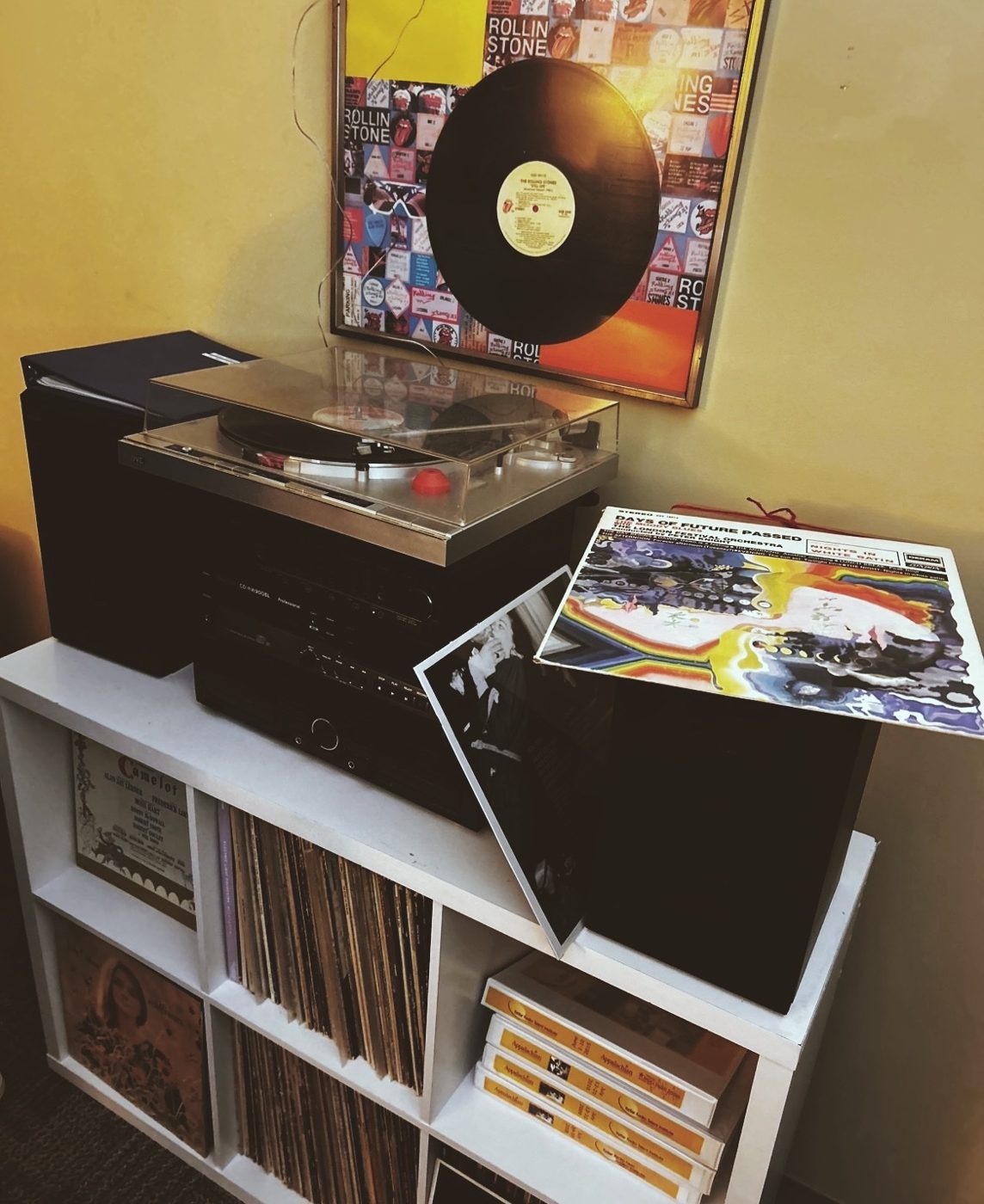
One more thing on that list is your old CDs. WASU's physical media collection disappeared before he arrived, and he's planning a donation drive to rebuild it, records, CDs, even tapes if anyone still has them. Part of it is nostalgia. Part of it is insurance, since digital files corrupt quietly and a damaged CD at least tells you it's damaged. Your old discs get new ears, too. He also wants turntables in the on-air studio so DJs can spin vinyl.
A few interesting donations have already found their way in. An early promo CD of Olivia Rodrigo's latest album showed up in packaging the size of a record. Joanna Newsom sent an actual CD, which lands a little harder once you know Hattie has idolized Newsom for years. WASU has picked up real vinyl too.
None of this is a sure thing. The HD plan needs a beefier transmitter and a second studio WASU doesn't have yet, plus an FCC that moves when it moves. Underneath all of it is a question the DJs can't answer either, which is how many people are actually out there. At 220 watts, the signal only reaches so far.
Still, the person in charge stops what he's doing when a kid leans in just to say he loved how a song ended.
You can hear all of it on 90.5 FM, through WASU's own stream, or through the same player that runs at the bottom of every page on left917. A lot of nights, it's Hattie and Ethan up late getting it ready. If you want to get involved, or you've got CDs, tapes, or records gathering dust, email Dave Blanks directly at blanksdr@appstate.edu, or just stop by the station on Rivers Street. Bands angling for a Corner Concert can reach out the same way.
Josh Owen edits left917. Send tips and corrections to studio@left917.net.
A left917 original · from left917
left917 is the High Country's local news & events
This is one story. We also cover every event on the calendar, weather and road alerts, and run a daily game. No app, no algorithm, no login.