
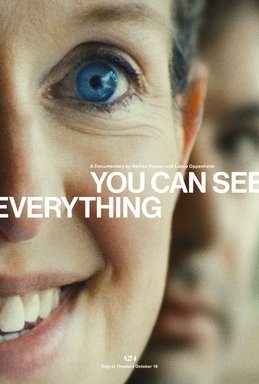
I recently showed up somewhere to do some background work on a story. I thought I could exist in the space in an informal way. When the subjects of the story became aware I was there, the reality became very formal very quickly, with talking points and pitches sent my way for over an hour, including a moment where I was encouraged to stop taking notes. Though I tried to explicitly break the formality with my subject, I nonetheless ended up questioning the individual to try and get a sense of who they were as a person and what they were doing. The individual refused to convey a sense of who they were as a person, sticking to talking points even when I could see the human behind the talking points (I would be more specific here, but I want to respect the fact that this was on background.) This interaction — particularly the way in which it momentarily felt like I was watching someone cling to something — came to mind when I started watching You Can See Everything.
But that isn’t all of what’s in the film. Obviously not. And, before we go any further, let me say that I’m finishing writing this on the day before Halloween with the assumption that you’ve seen the film or are about to see the film and that it’s fine for me to speak to you with a certain level of ‘inside baseball.’
For instance: one immediate thing you notice in the film is the way in which certain faces are portrayed, portrayed in a way that is reminiscent of how Christopher Anderson went about conducting his White House photoshoot for Vanity Fair. (The close-ups. The lightning. The incantatory eyes.) There’s the clarity of the craft of the whole of the film, which is somewhat lost in the way folks have been talking about this. (“Elizabeth Holmes documentary 'You Can See Everything' is a wild, mind-melting movie,” is how one typical headline runs.) Though the film heads in a fascinating structural and thematic direction, the audience is never left behind on the journey the film takes.
And then there’s the film asking us who Elizabeth Holmes actually is: is she on the spectrum? A con artist? (Something akin to a ‘magician,’ as Fielder put it?) Pathological? Someone filled with absurd levels of hubris? Would it be fair to say that her assault in college — which led to her dropping out — left her in a place where she would eventually give power of attorney to her partner?
In writing the previous sentence, I’m thinking a little bit of the beginning of Trauma Plot, and how — for the writer Jamie Hood —
I’d catch myself laughing, thinking how funny it was those men hadn’t killed me, and I was angry with them too, not because of what they’d done, but because they’d cheated me out of the death I longed for … that I was a person at all was not a serious proposition to me or anyone.
— and how that dovetails not just with a layer of Holmes's behavior here but also how Billy and Elizabeth Holmes are hung up on her being quoted as saying, in reference to Seyfried's depiction of her in The Dropout, 'They're not playing me. They're playing a character I created.'
Holmes is a probable mix of all of these things (I like Wesley Morris telling Bill Simmons that the film was almost a dialectic between liars and people who perform lies), but the question I'm wrestling with — as was Fielder, I’d argue — is just: what are the proportions of this mix? How much of each bit of self goes where? And is Amanda Seyfried available to help me figure it out?
It’s also worth stating plain a portion of the blizzard of lies Holmes pursued, as reported by numerous outlets: telling investors her machine was being used on the battlefields of Afghanistan and on medevac helicopters, when it never was; putting Pfizer’s logo on a report Pfizer hadn’t approved; persuading Pfizer to try an unreliable machine prototype on cancer patients in Tennessee; and, when her company ended up voiding two years of patient results, blaming quality control rather than the machines themselves, also while floating rare breast cancers to explain why women’s tests showed a certain result, an explanation her own lab director found implausible.
It’s worth bearing all of the above in mind when Holmes says to Fielder, “Why would I deceive you?”