
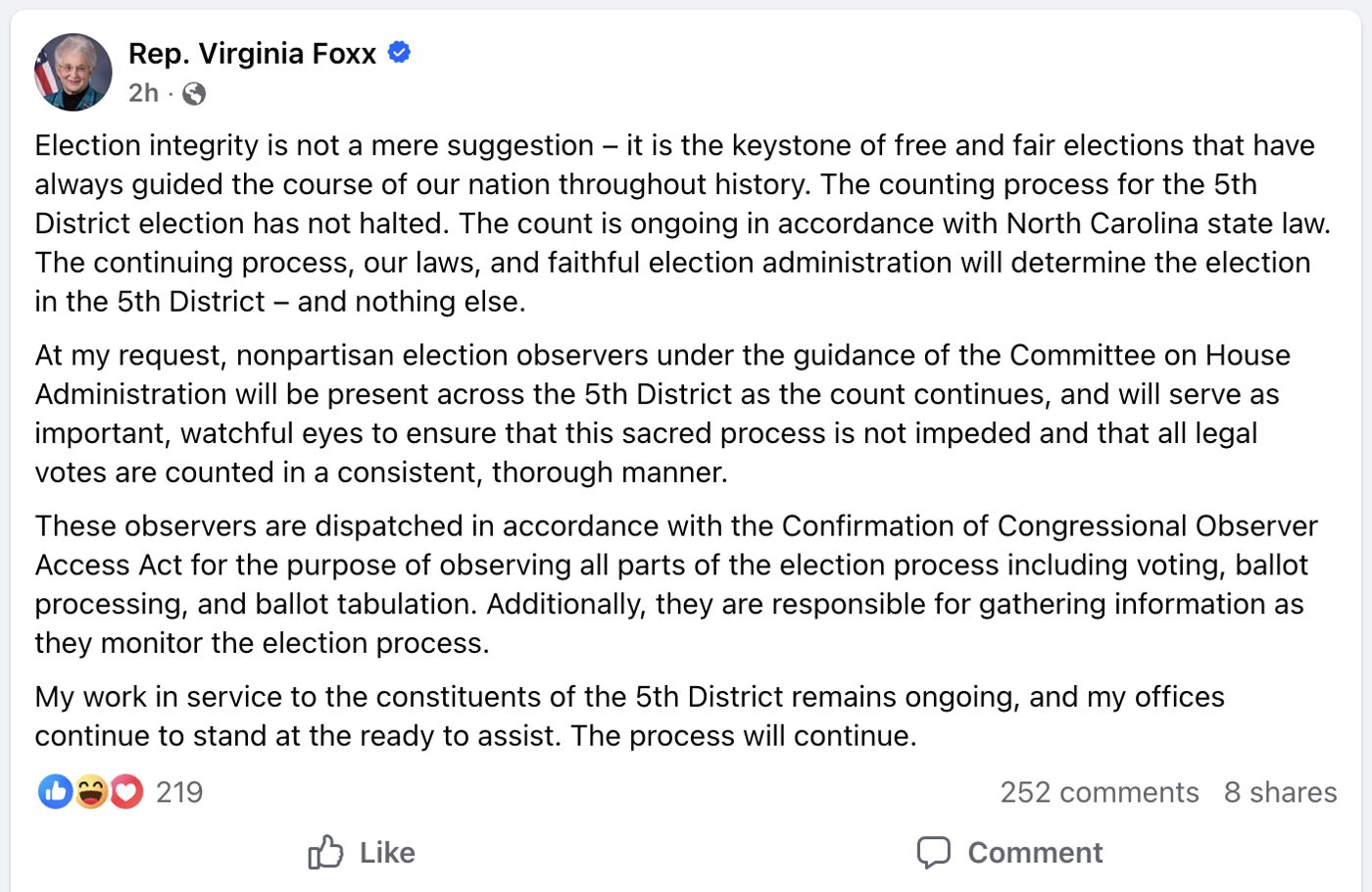
Rep. Virginia Foxx says House observers will be in the 5th District while the count continues. She posted it Friday on Facebook. "At my request," she wrote, nonpartisan observers will be present across the district. Election integrity, she wrote, is "the keystone of free and fair elections," and "faithful election administration will determine the election in the 5th District." Nothing else will, she added.
The post never names her opponent. It also doesn't say who designated the observers. Under the law, that job belongs to the chair or ranking minority member of the House Administration Committee, not to individual members. Foxx's post says she asked.
The race is separated by 99 votes. Chuck Hubbard, the Democrat, leads 139,034 to 138,935 in the unofficial State Board results.
The law behind the observers is two years old. It is short. It spells out what observers can do, what they can't, and who can throw them out.
Who they are
The Confirmation of Congressional Observer Access Act became law Oct. 4, 2024, after passing the House 413 to 1. An observer is a House or Senate employee, designated in writing by the chair or ranking member of the House Administration Committee (or the Senate Rules Committee). The House committee's chair is Rep. Bryan Steil, a Wisconsin Republican.
Foxx calls the observers nonpartisan. The committee's observer page says any House staffer can volunteer, interns excepted. It also says "Travel expenses for all Republican observers will be paid by the Committee." It says nothing about Democratic observers. The law lets the committee's ranking minority member designate observers too.
What they can do
States must give observers "full access to clearly observe" election procedures. That covers any area where a ballot is processed, tabulated, canvassed, recounted, audited or certified, before and after Election Day. Observers can ask questions of election officials.
What they gather goes to the committee, which says it keeps the file "to build a factual record" in case an election is contested.
What they can't do
The law bars observers from:
- handling ballots or election equipment
- advocating for a candidate or position
- reducing ballot secrecy or voter privacy
- interfering with a voter or with election administrators
An election official can remove an observer from the area with a reasonable basis to believe the observer has engaged in, or imminently will engage in, intimidation or deceptive practices the federal government prohibits, or disruption of voting, processing, tabulating, canvassing, recounting or certification. The official has 24 hours to notify the committee's chair and ranking minority member, with the reasons in writing. The committee can send a replacement.
Being there is not a reason to remove one. The law says "mere presence" is not enough.
What they don't do
They don't count ballots. They don't accept or reject provisionals. They don't certify anything. That stays with the county boards and the State Board.
What happens next
- Mon, Nov. 9, 9 a.m.: Watauga's sample hand-to-eye audit, where a bipartisan team compares hand counts to the machine counts. The county board says the public may attend, and the board offers a remote option.
- Tue, Nov. 10, noon: the deadline for voters to cure photo ID and absentee problems. That afternoon every county board meets to count provisional ballots and cured absentees. Times vary, the State Board says. Watauga's meets at 1 p.m. and Guilford's at 2 p.m., the Watauga Democrat and ABC45 report.
- Thu, Nov. 12, 5 p.m.: the last day military and overseas ballots can arrive and still count.
- Fri, Nov. 13, 11 a.m.: all ten counties canvass. The meeting is open to the public.
- Tue, Nov. 17, noon: recount demands for multi-county contests are due in writing to the State Board. A trailing candidate can demand one if the official margin is 1% or less of the total votes cast in the contest, the State Board says.
- Tue, Nov. 24, 11 a.m.: the State Board certifies the results.
The State Board's county chart lists 3,131 provisional ballots across the ten counties as of Nov. 5, and it is still being updated. Guilford has 1,606 of them, but Guilford is only partly in the district, so the district's number is lower. The State Board has not published a district-only count. Watauga has 344.
Observers can watch all of it. None of it is theirs to decide.
What we don't know
No one has said how many observers are coming. No one has named a county or a site. The committee's observer page never mentions North Carolina or 2026, so the deployment rests on Foxx's word so far. We found no response yet from the State Board or the county boards.
Hubbard has said he trusts the Board of Elections to finish "correctly and fairly." That predates Foxx's post. His campaign did not immediately respond to the Watauga Democrat about the observers.