
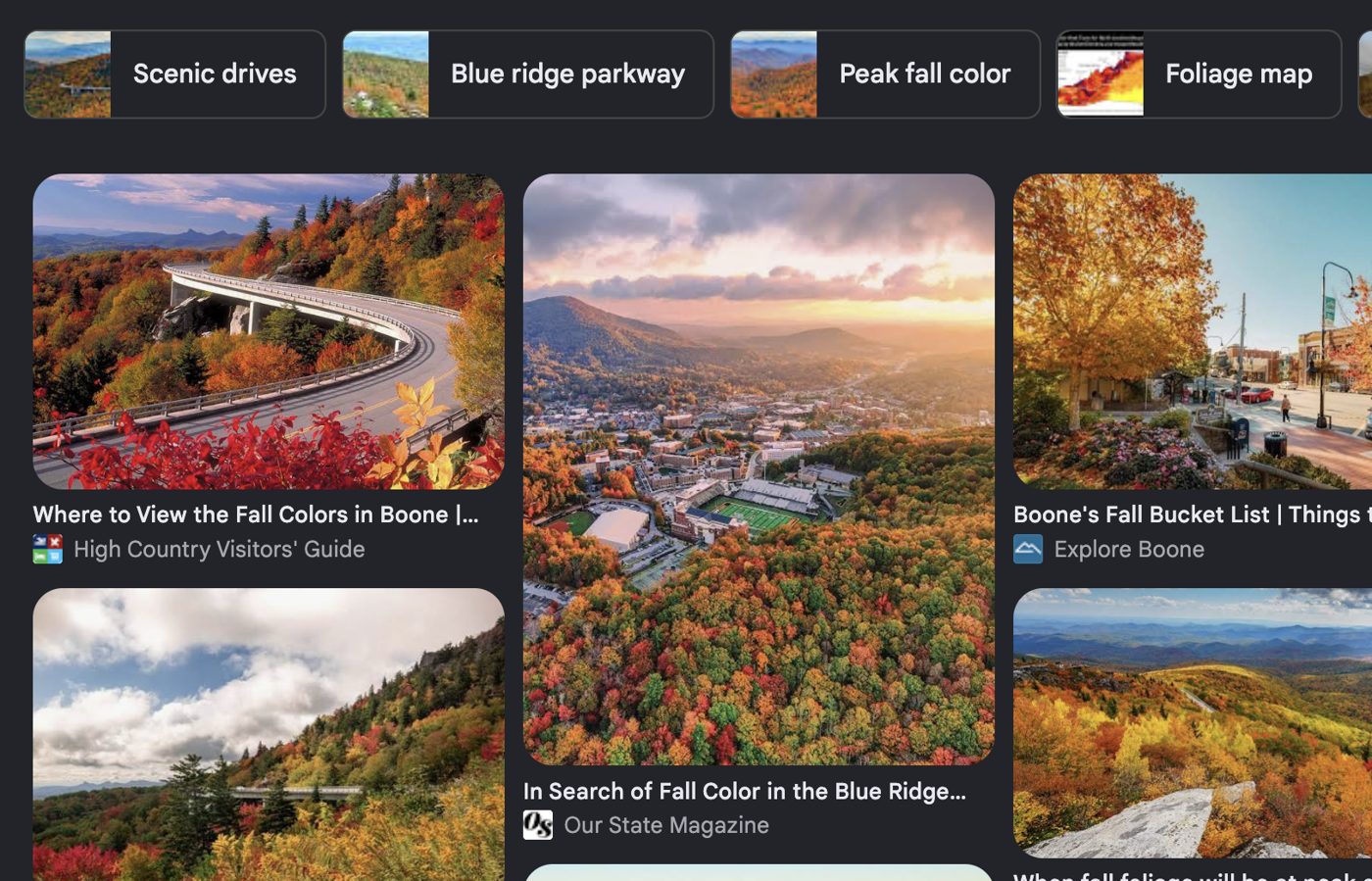
The leaves are late. Howard Neufeld said so in late September from Howard Knob Park, about 4,000 feet above Boone, where WRAL found him surveying the ridgelines. He scouts weekly from late summer, photographs the color on his phone and asks the people he meets to rate it from one to 10. Neufeld retired this year from Appalachian State after 39 years teaching biology and has tracked fall color in these mountains for nearly 20 years. If he says the leaves are late, they’re late.
Boone and Blowing Rock build their year around a few weeks of color, so we started with an assumption. A late peak, we figured, would hurt the people who depend on October. We asked a tourism director, an innkeeper and a country fair. The result, a week late is something their calendars absorb.
The color
September in Boone averaged 68.5 degrees, according to WUNC. Normal runs between 64 and 66. Neufeld's rule, built on nearly 20 years of fall transitions, is that every degree above the September average pushes peak color back about two days. That puts this year roughly a week behind. Peak here usually lands between Oct. 10 and 20, and this year's was pegged for the third week.
Heat does not just delay the show. It blurs it. The forest does not turn on one schedule. Maples respond to temperature, Neufeld said, while dogwoods may lean more on daylight. Oaks bring up the rear, coloring after the week or so when most trees peak. Around Boone the forest is primarily made of white and black oak and hickory, with few reds, which is one reason he always rates the town's color a four or five out of 10.
If it gets warm, the result is a longer season and patchier color. It is also noisy. Neufeld says 2018 and 2019, the two warmest years, pushed peak back 10 to 14 days, making them the two latest in his record.
His records show how much the timing has started to swing. From 2008 through 2016, all but one season peaked inside Oct. 10 to 20. Since 2017, it has ranged from on schedule to about two weeks late, and the swings are twice as large, Neufeld said. He does not know whether that is incipient climate change.
What October is worth
October is the Blue Ridge Parkway's biggest month. About 2.2 million people visited the Blue Ridge Parkway in October 2023, roughly 13 percent of the year’s total, according to park service figures reported by the Asheville Citizen Times.
And these visitors aren’t just passing through. In Blowing Rock, October brings close to 15 percent of the year’s occupancy tax collection, Tracy Brown, executive director of the town’s tourism development authority, said by email. At the Hemlock Inn, owner Bryan Summers said, a quarter of the year’s gross income comes in October. Across the region, Neufeld has put the fall season at $600 million to $800 million over three months, as he told WFDD last year. In Watauga County, tourism supports 3,016 jobs and $129.11 million in payroll, according to Explore Boone.
The calendar does not care
The leaves moved. The events did not. An obvious example is the Valle Country Fair, which has been held on the third Saturday in October for almost 48 years. This year that Saturday was Oct. 17. The fair typically draws about 10,000 people. A member of the fair’s leadership team said it made no changes for the late color. Valle Crucis is a backdrop whether the leaves are at peak or not, the leadership team member said, and early or late color does not touch what the fair is about, “neighbors helping neighbors.” Banner Elk’s Woolly Worm Festival shares the third weekend of October with the Valle Country Fair, and has since 1978. This year that was Oct. 17 and 18, and organizers say it typically draws more than 20,000 people.
We're grateful for any and all color! - Valle Country Fair leadership
A fair that started as a bet on the leaves no longer needs them. Blowing Rock's lodging works the same way. Reservations for overnight stays are made well in advance of the month, Brown said, so a late peak does not empty the rooms. What shifts is the day-trip crowd, which comes up the mountain around peak after regional media reports. Folks are coming regardless of when peak lands, he said, because nobody can predict it. Peak tends to arrive mid-month. A later one may extend the leaf-peeping season by a week or so.
Bryan Summers, who owns the Hemlock Inn in Blowing Rock with his wife, said by email that the month runs on a fixed calendar. In his experience, peak comes about three days after the first frost, which generally lands around the second week of October. The high country's elevation helps, he said, because you can always find good leaves somewhere. A late peak does not rattle the inn because the month is predictable every year, he said, and for staffing it is simply good management.
There's never an October surprise.
Weekends are the busiest stretch regardless, Brown said, and locals plan around them. They book their favorite restaurants ahead, run errands early in the day, and get out midweek, when traffic is lighter and businesses are a little slower. The season only lasts a few weeks, he said, and residents understand it.
Neufeld saw the crush himself on Sunday, Oct. 18. It was the most crowded he has seen the Parkway in a long time, he said, with stop-and-start traffic running south from just before Rough Ridge to the viaduct and every pull-off full. His site draws 20,000 to 40,000 hits a week this time of year, he said, though he cannot tell how many visitors come because of it.
What would make them worry
So the leaves can run a week late and everyone shrugs. And the idea of worrying about climate change's impact on tourism might be more complicated than we thought. Trees respond to different cues, and a straight line from one year to the next can prove difficult to draw. The leaves changing two weeks late, as in 2018 and 2019, is about as late as Neufeld expects peak to run, because the shortening days of fall eventually override warmth.
It's a fact worth underlining again, temperature plays a role in how and when the leaves change. A 2023 study in Science found that warming before the summer solstice sped up the start of what's known as 'leaf senescence' by about 1.1 days per degree Fahrenheit, while warming after it stretched the process out by about 1.4 days per degree. NOAA backs this up, saying that warmer falls "may delay the arrival and duration of peak color."
North Carolina has warmed more than 1 degree Fahrenheit since 1900, rising steadily since the cool 1960s and 1970s and, according to the federal state climate summary, running consistently above average since the late 1990s. The southern Appalachians are a "warming hole," Neufeld says, an anomaly of normalcy in the expected climate trend, and the records for Boone show no significant warming trend so far. He thinks the region is in an early phase where warming cannot yet be separated from the noise.
A 2015 meta-analysis in Annals of Botany pooled 64 studies with observations from 1931 to 2010 and found leaf senescence in northern deciduous trees has been delayed over time and with temperature, most strongly in North America and at latitudes from 25 to 49 degrees north, a band that includes Boone. No published record we could find of High Country peak dates reaches back further than Neufeld's own, which starts in 2008, he said. The closest long record we found is in Maine, where a 2023 study in Landscape Ecology that put peak color at Maine's Acadia National Park almost two weeks later than in the 1950s, with September temperature the strongest predictor.
It's hard to see a shift from within something as large as the climate. We look out the window and we see leaves. It's a scale of obviousness that escapes easy talk, because look at all those leaves! There they are! What's more, peak leaf season moves with elevation, species and each year's weather, so the leaves turning a few days late feels like it falls within the margin of error. This year the high elevations ran about two weeks behind, the middle elevations about a week, and the foothills are still on a normal late-October schedule, Neufeld said. The change hasn't been enough to disrupt anyone's plans.
No one we spoke with described planning for a steady slide either. The people we spoke with in Blowing Rock make a living welcoming people to see the changing colors. But an odd thing sits beneath all this, a season that sells the color is selling the thing that is moving.
Habits do not change overnight. A fair on the same Saturday for almost 48 years is a habit. So is a room booked well ahead. A week late doesn't cost anyone anything, and everyone we talked to more or less said so. The climate changing casts a new light on what tourism might mean, even if it, by all appearances, things still look the same.